Parte de Creative (m)otherhood
2024-2025
The room holds time

Artistic research / composition · 2025
The room holds time investigates the relationship between lived experience, data and musical time. The piece emerged from the experience of early motherhood and from an attempt to translate the strange, suspended temporality of caring for a newborn into a musical and performative system.
The work was developed with Catchpenny Ensemble with support from the City of The Hague.
Starting point
This was the first piece I wrote after giving birth.
During the first months of motherhood, my experience of time changed radically. Days became organised around feeding, sleeping and caring for my baby. Hours could feel endless, while entire days seemed to disappear. Repetition became a form of structure, but there was always an element of unpredictability: I never knew exactly how a day was going to look like, which made it quite difficult to organise times to create.
The starting point for The room holds time was therefore not an abstract idea of motherhood, but my own everyday experience and the data I had been collecting throughout it.
Collecting the data
For approximately 8 months after my baby was born, I used a baby-tracking application to record different aspects of our daily routine.
I recorded:
- breastfeeding
- naps and overnight sleep
- nappy changes
- awake time
The app became a kind of external clock for the first months of motherhood. I became very connected to it, constantly checking when my baby had last eaten, how long she had slept, and what had happened during the day.
When I eventually stopped using the app, I realised that it had also been a source of anxiety. Whenever I was not around my baby, often attempting to work, I kept looking at the app to see if she was sleeping, or how long it had been since her last nappy change. I believe now that the app made it really hard for me to focus on other things when I was not with my baby. Nevertheless, the accumulated data provided a detailed record of the repetitive rhythms that had structured my experience of those first months, and provided me with an idea (and the entire structure) for The room holds time.
From data to a day
When I began analysing the data, I noticed that my baby followed a relatively consistent routine. Different days and weeks were surprisingly similar.
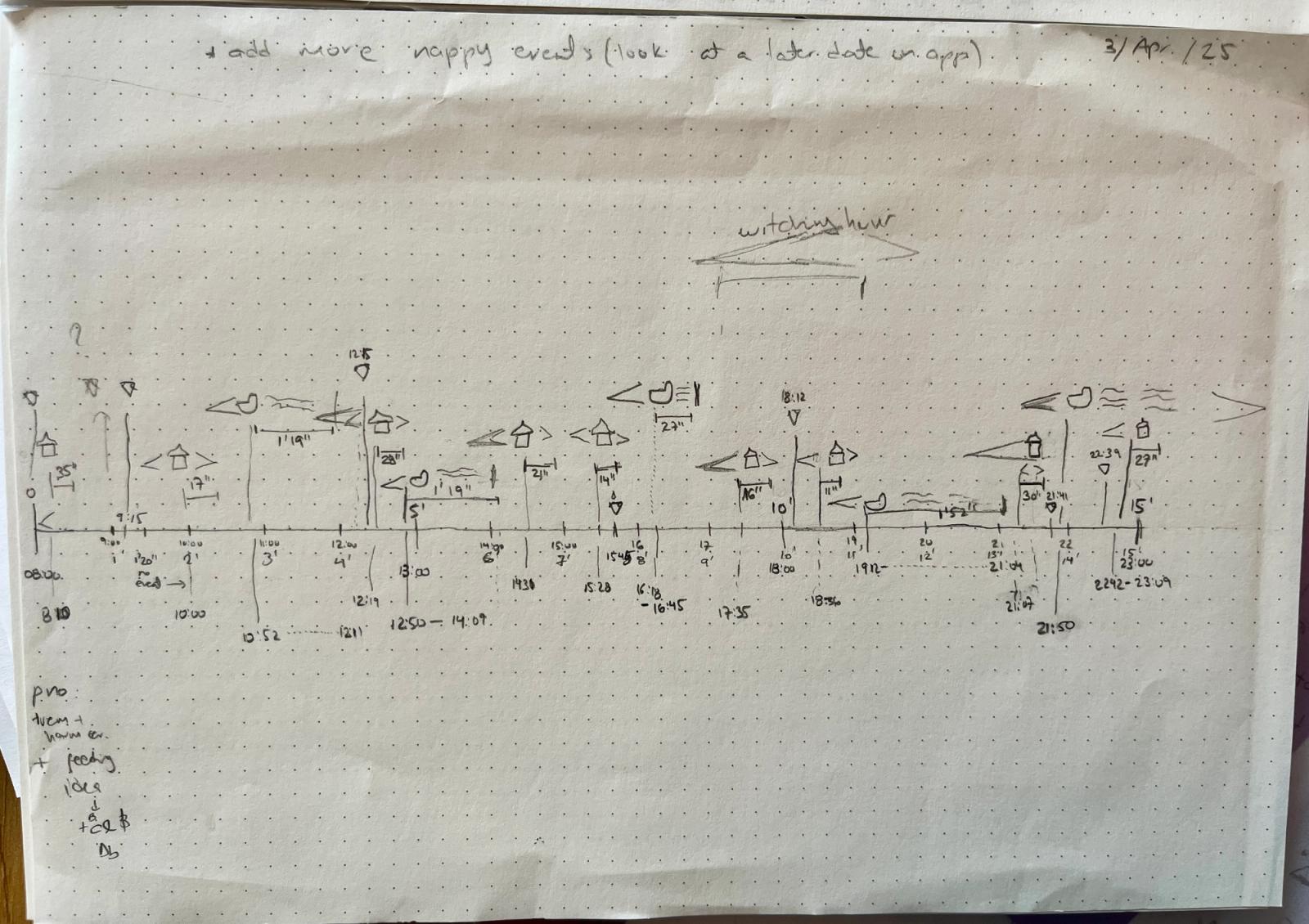
Rather than reproducing one particular day, I therefore created an average day based on the data I had collected.
I mapped the period from waking in the morning to going to sleep at night. This resulted in an 11-hour temporal map.
The decision to work with 11 hours was simultaneously practical and conceptual: the 11-hour period would become an 11-minute composition, with one hour of lived time corresponding to one minute of musical time.
The resulting map became the blueprint for the piece.
Translating everyday events into musical behaviour
Each type of event (sleeping, feeding, nappy change, awake time) was assigned its own musical character.
Sleep became the most stable and serene material: long sounds, soft dynamics and sustained textures. The percussion uses glockenspiel in these sections, while the other instruments sustain longer tones.
Nappy changes, by contrast, became moments of abrupt disruption. The actual events were short— only four or five seconds—but when translated through the one-hour-to-one-minute scale, they became intense, compressed musical episodes. These sections are loud and rhythmically complex, creating moments of chaos that arrive suddenly and disappear just as quickly.
Breastfeeding occupies a space between stability and uncertainty. It begins with agitation—the baby is hungry—and gradually becomes calmer as feeding continues, often leading directly into sleep. The musical material follows this trajectory, moving from greater activity towards calm and suspension.
These relationships are not intended as literal musical illustrations of particular activities. Instead, they translate the qualities of the experience into musical behaviour.
A score between stability and uncertainty
An important part of the creative process was deciding how much of the piece should be fixed and how much should be free. The prompt for this piece for Catchpenny Ensemble was to create an interactive visual score. Therefore, creating a fully notated score was not an option. The experience I was trying to represent was structured by routines, but those routines were never completely predictable. A baby might sleep for twenty minutes or two hours. A feeding might be short or unexpectedly long. Something could always interrupt the expected sequence.
I therefore developed a hybrid system combining a fixed temporal structure with interactive and indeterminate elements.
The ensemble is divided into two groups.
The piano and percussion form the stable layer of the piece. Their parts are traditionally notated and follow a click track. They provide a continuous sense of pulse and precision.
The flute, clarinet and double bass form the unstable layer. These instruments respond to the video score rather than following a completely fixed notation. Their behaviour can therefore change according to the visual information they receive.
The result is a musical system in which stability and instability coexist: a precise clock continues underneath a constantly changing, responsive layer.
Developing the interactive score
The video score was developed in collaboration with an external artist. I provided the underlying structure: a list of events, their duration, their position within the 11-hour map, and whether each section should be fixed or free.
| Time | Compás | Evento | Instruments | Type material | Animación | Feeling |
|---|---|---|---|---|---|---|
| 00:00 - 00:06:00 | 1 – 2 | 2 bar count in | – | |||
| 00:06:00 - 00:16:12.40 | 3 – 6+2b | Wake up | Piano & perc. | Despertar que pronto se convierte en hambre | ||
| 00:16:12.40 - 00:51:00 | 7-2b – 17 | Feed (35") | todos | libre | sólo inicio del evento | Hectic/urgent |
| 00:51:00 - 01:21:00 | 18 – 27 | No event 1 | todos | fixed | ataques de fl, cl, db | |
| 01:21:00 - 01:26:06.20 | 28 – 29+3b | Nappy 1 | todos | polyrhythms (notated) | inicio evento y caos | rushed/unstable |
| 01:26:06.20 - 02:06:00 | 30-1b – 42 | No event 2 | todos | fixed | ataques de fl, cl, db | se va convirtiendo en hambre |
| 02:06:00 - 02:23:06.20 | 43 – 48+3b | Feed 2 (17") | todos | libre | sólo inicio del evento | Hectic/urgent |
| 02:23:06.20-02:58:12.40 | 49-1b – 60+2b | No event 3 | todos | fixed | ataques de fl y cl | se va convirtiendo en sueño |
| 02:58:12.40-04:21:00 | 61-1b - 87 | Sleep 1 (1'19") | todos | fixed | ataques de fl, cl, db | va despertando con escalas ascendentes |
| 04:21:00 - 04:25:12.40 | 88 - 89+2b | Nappy 2 | todos | polyrhythms (notated) | inicio evento y caos | rushed/unstable |
| 04:25:12.40 - 04:56:06.20 | 90-2b –99+3b | Feed 3 (28") | todos | libre | sólo inicio del evento | Hectic/urgent |
| 04:56:06.20 - 06:15:00 | 100-1b – 126 | Sleep 2 (1'19") | todos | fixed | ataques de fl, cl, db | va despertando con escalas ascendentes (perc y pno) |
| 06:15:00 - 06:37:12.40 | 126 – 133 +2b | No event 4 | todos | fixed | ataques de fl, cl, db | se va convirtiendo en hambre |
| 06:37:12.40 - 06:58:12.40 | 134-2b – 140+2b | Feed 4 (21") | todos | libre | sólo inicio del evento | Hectic/urgent |
| 06:58:12.40 - 07:34:12.40 | 141-2b – 152+2b | No event 5 | todos | fixed | ataques de fl y cl | se va convirtiendo en hambre |
| 07:34:12.40 - 07:48:00 | 153-2b – 156 | Feed 5 (14") | todos | libre | sólo inicio del evento | Hectic/urgent |
| 07:48:00 - 07:53:06.20 | 157 –158+3b | Nappy 3 | todos | polyrhythms (notated) | inicio evento y caos | rushed/unstable |
| 07:53:06.20 - 08:20:06.20 | 159-1b - 167+3b | Sleep 3 (27") | todos | fixed | ataques de fl, cl, db | despertar abrupto |
| 08:20:06.20 - 09:10:12.40 | 168-1b – 184+2b | No event 7 | todos | fixed | ataques de fl, cl, db | |
| 09:10:12.40 - 09:14:06.20 | 185-2b+185+3b | Nappy 4 | todos | polyrhythms (notated) | inicio evento y caos | rushed/unstable |
| 09:14:06.20 -11:09:00 (fin) | 186-1b – 223 (fin) | Sleep + feed | todos |
The video translates these different states into a minimal visual environment. Different types of events have different visual behaviours: sleeping sections become calmer and more spacious, while the more chaotic sections generate visual noise and increased activity.
For the flute, clarinet and double bass, the video also determines when individual sounds occur.
The performers receive pitch material for each section, while the video determines the timing. Visually, each sound is represented by a moving dot and tail. When the dot reaches a vertical line on the screen, the performer attacks the note; the length of the tail indicates its duration.

The system creates something resembling a musical version of a rhythm game: the performers have defined material, but must respond to the changing visual score in real time.
For free sections, performers can choose from a selection of pitches. In fixed sections, the pitches are predetermined. Registers and dynamics remain free.
The final system was developed through rehearsal. Halfway through the process, I worked with Catchpenny Ensemble in a workshop, testing the system and observing how the performers responded to it. Their feedback led to adjustments in the score before the final version was completed.
Composing with limited time
The research was inseparable from the circumstances in which the piece was written.
I had never before experienced such a dramatic change in my relationship to composing. Before motherhood, composing generally involved spending long periods of uninterrupted time thinking, experimenting, listening, writing, and returning to the material. I could follow an idea for as long as it needed.
After giving birth, I could only compose in the fragments of time available to me.
Often, that meant composing while my baby slept. Even when my husband was caring for her and I technically had more time, I found it difficult to concentrate for long periods. Part of my attention remained elsewhere: Was she sleeping? Was she okay? How long had she been asleep? When had she last eaten?
The same app that provided the data for the piece also contributed to this state of heightened attention.
I found it extremely difficult to generate musical ideas. My concentration felt fundamentally different, and the piece developed much more slowly than I was accustomed to. I would write something, dislike it, stop, return to it later, and often find that the available time had already disappeared.
This became an unexpected part of the research and the compositional process.
The piece was not only about a changed experience of time. It was also made under radically changed conditions of time, which had an impact on the final result of the work.
Reflection
Looking back, the central tension of the piece—between a stable clock and an unpredictable, responsive layer—feels closely connected to my experience of early motherhood.
The data gave me the illusion of being able to measure and organise time. I could record exactly when something happened and for how long. But the experience itself remained unpredictable and emotionally charged.
The resulting composition therefore sits between these two forms of time:
measured time and lived time.
The 11-hour period is compressed into 11 minutes, but the compression does not eliminate the feeling of duration. Instead, it makes visible the strange paradox of early motherhood: repetition can make time feel suspended, while the accumulation of small events makes it pass incredibly quickly.
The room holds time is ultimately an attempt to give this paradox a musical form.